STEM and Computing Education Research

About this research line

We develop evidence-based tools and teaching methods for computational thinking and AI, reaching tens of thousands of students and teachers across Flanders and beyond.

Introduction

AIRO is committed to improving computer science and STEM education. We develop evidence-based tools that facilitate the learning process for both teachers and students. To achieve this goal we perform field research collecting relevant quantitative and qualitative data by interacting with both teachers and students. This data is combined with our experience in computer science to develop tools that meet the educational requirements.

Learners

A large part of our research goes into analyzing how learners learn to program and how the learning context influences the learner’s behavior. To analyze the learning process we need to collect programming data from students who learn to program. We set up a programming environment where the programmer’s interactions and programming code are logged. This gives us the ability to understand how students approach computing tasks. In the Create or Fix experiment we identified differences between creating programs versus fixing incorrect programs as a teaching technique for computing. We saw for instance that debugging incorrect programs generally invoked less interaction with the programming code, but more program executions compared to creating programs from scratch.

Educators

The main goal of our teacher-centered research is to identify what withholds teachers from implementing STEM subjects in their classrooms. Teachers often describe their own shortcomings as the reason for being hesitant towards teaching certain STEM subjects. Identifying what these shortcomings are and finding a way for teachers to overcome them is an important element of our research. Some of our experiments have shown that teachers often lack the necessary content knowledge to be confident enough to teach STEM subjects. One specific skill teachers often lack is programming. Consequently, a lot of our research focuses on facilitating the integration of programming into primary and secondary education. More recently our perspective has been expanded from looking at improving teaching to improving assessment for programming. Our aim is to create a didactical framework teacher can use to effectively assess programming assignments.

Tools

To have complete control over the research data we collect, we design and develop all the necessary tools in-house. Consequently, our tools are made to perfectly fit our experimental designs. These tools include the required hardware and software for teaching physical computing as well as research-based, classroom validated instructional designs. Everything we produce is offered to the teaching community free of charge under a creative comments license. Some examples are the WeGoSTEM and AI at School projects. More information about other projects can be found on the outreach page.

Dwenguino Simulator

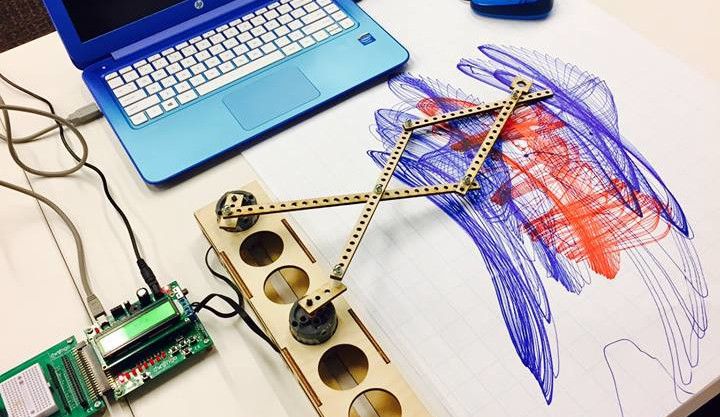
Since previous research has shown that teaching programming through physical systems has many pedagogical advantages, we have created a graphical programming environment that allows learners to program a physical system. These physical systems are based on the Dwenguino microcontroller platform. The Dwenguino platform was specifically designed to facilitate the use of physical systems in a classroom and is modular enough to be able to create multiple different physical systems. Consequently, a wide range of physical systems can be controlled using our programming environment. Additionally, the environment includes a simulator which decouples learning programming from learning about the limitations in the physical world simplifying the learning experience.

Towards AI-driven Feedback

Enabling teachers to be more effective requires the right tools. Using our programming environment, we collect data about how learners acquire programming skills. We leverage this data by using machine learning techniques to provide teachers with the information they need to improve the learning efficiency of the students in their classroom. In a first step, we aim to create relevant visualizations for teachers to give them more insight into how their students learn. The second step is to use this information as input for an automated feedback system, further improving personal learning experiences.

Active researchers

Related publications

Teachers’ computational thinking content knowledge : development of a measurement instrument

Sara Monteyne, Charlotte Struyve, Natacha Gesquière, Tom Neutens, Francis wyffels, Johan Braak, Koen Aesaert
In COMPUTERS & EDUCATION 2025
BIBLIO
Abstract
Computational thinking has become an integral component of curricula worldwide, necessitating teachers to develop this competence in their students. To effectively meet these curricular requirements, teachers themselves need a solid foundation of computational thinking content knowledge, which refers to the understanding and skills they possess in this area. However, despite widespread recognition of this need, few studies have rigorously examined teachers’ content knowledge in this domain. Addressing this gap requires the development of high-quality measurement tools. This study details the development of an instrument, created as part of the International Computer and Information Literacy Study (ICILS) 2023 in Flanders, to measure lower secondary school teachers’ computational thinking content knowledge in a valid and reliable way. The article first outlines the construction process of the instrument, which involved close collaboration with experts in the field and drew upon the framework of Fraillon and colleagues (2023). Following this, the instrument’s psychometric properties are presented, which include both item-level and overall instrument characteristics. These properties were evaluated using data from a sample of 352 participants, applying both Classical Test Theory and Item Response Theory. The final tool consists of 16 multiple-choice and short constructed response questions. The results indicate favorable item and overall instrument characteristics, thereby affirming its potential to measure the intended construct in a valid and accurate way.

Computational thinking competencies of Flemish college students : vision on data collection

Willem Lapage, Francis wyffels, Tom Neutens
In Colloque Didapro 10 sur la Didactique de l’informatique et des STIC 2024
BIBLIO
Abstract
Computational thinking has become an increasingly vital competence in our technologically driven world. As a problem-solving methodology, it can be considered a competence that transcends disciplines and plays an important part in multiple diverse fields. It has also gained a more prominent role in the Flemish education system. Therefore, assessing computational thinking and collecting the necessary data to do so has become increasingly important during students' education. This paper describes how the computational thinking competencies of college students can be monitored in a controlled environment. By combining a literature study as well as knowledge of the context wherein the data will be collected, a subset of data sources has been selected that show potential for a multimodal assessment of computational thinking. This paper outlines an envisioned data collection method to gauge computational thinking competencies among second-year computer science engineering students at Ghent University. The desired end result is a collection of data that can be managed and processed as an input source to assess computational thinking and affect educational practices. This paper describes a way of collecting data that shows potential for a multimodal assessment of computational thinking. It also opens the door for future research exploring the potential of AI-driven methods for automatic assessment and the development of interactive visualisation of said assessments.

Assessment of code, which aspects do teachers consider and how are they valued?

Tom Neutens, Kris Coolsaet, Francis wyffels
In ACM TRANSACTIONS ON COMPUTING EDUCATION 2022
BIBLIO
Abstract
In many countries, computer programming is becoming an integral part of the secondary school curriculum. However, many teachers, especially in the first years of Flemish secondary school, have limited experience with teaching programming. To improve their knowledge about programming, many different types of professional development programs have been proposed. Nevertheless, these programs mostly focus on technical skills and less on pedagogical skills. One aspect that is often overlooked in these programs is how teachers can assess code. To get insight into what teachers currently value when assessing code, we designed an experiment that analyzes the different aspects teachers consider during the assessment of code. During the experiment, the teachers (N=13) assess a set of programs from five different fictional learners. After the assessment, they participated in a structured interview giving us insight into the assessment process. We evaluated the transcripts of the interviews using deductive thematic analysis using a coding schema defining the different aspects of code that can be assessed. Additionally, we linked the assessment strategies of teachers to their teaching experience. Our results indicate that many teachers are unaware of the different concepts that can be part of the assessment of code which might lead to inaccurate or invalid feedback. Moreover, although our experimental group was too small to draw hard conclusions about the inter case results, our results indicate that the number of concepts considered by teachers seems to increase with experience. These results provide an initial insight into the code assessment practices of teachers and reveals interesting pathways for future research into the assessment of code.
See more

Related open-source

See more