AI for Agriculture & Plant Science

About this research line

We develop AI-driven sensing and computing for plant science and agriculture.

Our work in this domain combines custom sensor platforms, AI-based detection and segmentation, and simulation tools for crop modelling. This connects our robotics and machine learning expertise with agriculture, forestry, and fundamental plant biology.

Sensing and phenotyping

We design sensor systems that capture plant and environmental state across modalities. MIRRA is our modular, cost-effective microclimate monitoring system for real-time remote applications, combining multiple environmental sensors in a compact, low-power package deployable in forests, greenhouses, and open fields. In collaboration with UGent-Woodlab, we developed a high-throughput pipeline for quantitative wood anatomy that pairs gigapixel macro photography with YOLOv8-based segmentation of tree ring vessels and rays, bringing automated analysis to a field that has relied on manual microscopy.

MIRRA microclimate monitoring module

MIRRA: modular microclimate monitoring for real-time remote field and forest applications.
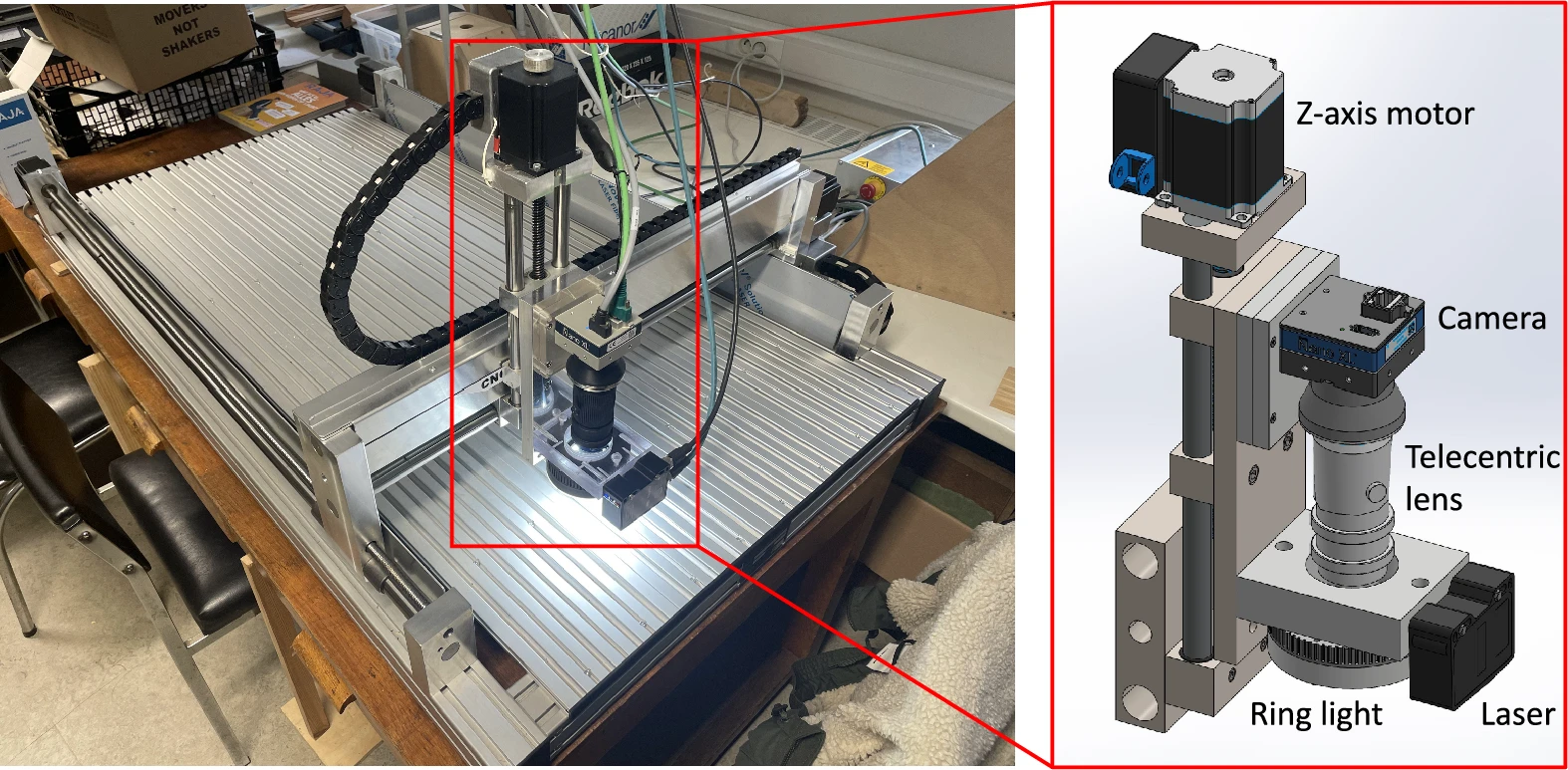
High-throughput wood anatomy pipeline

Gigapixel imaging and deep learning segmentation for quantitative wood anatomy.

Detection and segmentation for plant biology

Across our work in plant biology and agriculture, AI-based detection and segmentation provide a common toolkit. For example, we developed stomata detection on leaf microscope images for plant physiology research; the same work was reused for the KIKS project at Dwengo, illustrating how applied research can also unlock educational outreach.

Stomata detection on a leaf microscope image

Stomata detection on a leaf microscope image.

As another example, in collaboration with Meise Botanic Garden and KU Leuven we analysed the agro-morphological diversity of 70 Robusta coffee genotypes from the Yangambi collection in the Democratic Republic of the Congo, identifying promising genotypes for green bean quality and drought tolerance.

The broader aim is to make image-based phenotyping and physiological measurement scalable across species, traits, and field conditions.

Simulation intelligence for crop science

Simulation intelligence merges scientific computing with AI through interconnected motifs: surrogate modelling, agent-based modelling, differentiable simulation, probabilistic programming, causal inference, and program synthesis. We survey how these motifs advance plant and crop modelling, from molecular processes to ecosystem management. Surrogate modelling, agent-based approaches, and differentiable programming already have concrete plant science applications. Others, such as open-ended optimisation and probabilistic programming, remain largely unexplored in this domain.

Collaborations

We collaborate with ILVO (Flanders Research Institute for Agriculture, Fisheries and Food), Meise Botanic Garden, INERA Yangambi (DRC), and the Department of Data Analysis and Mathematical Modelling at Ghent University. The PlantComp workshop serves as the meeting point for our interdisciplinary network.

Active researchers

Related publications

Development of an agricultural robot taskmap operation framework

Axel Willekens, Sébastien Temmerman, Francis wyffels, Jan Pieters, Simon Cool
In JOURNAL OF FIELD ROBOTICS 2025
BIBLIO
Abstract
Robotic technology in precision crop farming has the potential to minimize inputs, such as labor, fertilizer, or plant protection products, maximizing the net yield while reducing the environmental impact. To maximally exploit the benefits of precision crop farming, it has to be applied continuously over multiple years, which requires (robotic) technology for a wide range of agricultural operations. Researchers need access to (noncommercial) robot platforms with complete mechanical and software controllability to investigate new applications that could unlock the true potential of precision farming. This study presents the agricultural robot taskmap operation framework (ARTOF), which provides common functionality for robots with different vehicle configurations to execute task maps in crop farming applications based on global navigation satellite system positioning. The two-layered software stack has a mechatronic layer and an operational layer. The mechatronic layer performs motion control and includes machine safety to meet the required performance level in correspondence with European regulations. The operational layer performs autonomous implement and navigation control. Add-ons interact with the operational layer using the ARTOF Redis interface and increase flexibility. Hardware-in-the-loop testing enables static end-to-end testing and minimizes the developing time and operational faults when developing new functionality. To demonstrate the framework's flexibility, it was integrated into four in-house developed and modified agricultural robots with four-wheel drive, four-wheel steering (4WD4WS), skid steering, and Ackerman steering vehicle configurations. These robots performed 11 applications under real practice conditions in arable farming and horticulture for—in total—more than 11 km of field application. The power consumption, navigation accuracy, and software usability were evaluated. An average navigation accuracy of 1.0 cm was achieved during hoeing with a 4WD4WS robot using the newly developed navigation controller. This new open-source software framework enables the rapid validation of agricultural robotic research to broaden the number of precision crop farming applications and fully exploit their potential.

From leaf to label : a robust automated workflow for stomata detection

Sofie Meeus, Jan Bulcke, Francis wyffels
In ECOLOGY AND EVOLUTION 2020
BIBLIO
Abstract
1. Plant leaf stomata are the gatekeepers of the atmosphere-plant interface and are essential building blocks of land surface models as they control transpiration and photosynthesis. Although more stomatal trait data is needed to significantly reduce the error in these model predictions, recording these traits is time-consuming and no standardized protocol is currently available. Some attempts were made to automate stomatal detection from photomicrographs, however, these approaches have the disadvantage of using classic image processing or targeting a narrow taxonomic entity which makes these technologies less robust and generalizable to other plant species. We propose an easy-to-use and adaptable workflow from leaf to label. A methodology for automatic stomata detection was developed using deep neural networks according to the state-of-the-art and its applicability demonstrated across the phylogeny of the angiosperms. 2. We used a patch-based approach for training/tuning three different deep learning architectures. For training, we used 431 micrographs taken from leaf prints made according the nail polish method from herbarium specimens of 19 species. The best performing architecture was tested on 595 images of 16 additional species spread across the angiosperm phylogeny. 3. The nail polish method was successfully applied in 78% of the species sampled here. The VGG19 architecture slightly outperformed the basic shallow and deep architectures, with a confidence threshold equal to 0.7 resulting in an optimal trade-off between precision and recall. Applying this threshold the VGG19 architecture obtained an average F-score of 0.87, 0.89 and 0.67 on the training, validation and unseen test set, respectively. The average accuracy was very high (94%) for computed stomatal counts on unseen images of species used for training. 4. The leaf-to-label pipeline is an easy-to-use workflow for researchers of different areas of expertise interested in detecting stomata more efficiently. The described methodology was based on multiple species and well-established methods so that it can serve as a reference for future work.

Century‐long apparent decrease in iWUE with no evidence of progressive nutrient limitation in African tropical forests

Marijn Bauters, Sofie Meeus, Matti Barthel, Piet Stoffelen, Hannes De Deurwaerder, Félicien Meunier, Travis W. Drake, Quentin Ponette, Jerôme Ebuy, Pieter Vermeir, Hans Beeckman, Francis wyffels, Samuel Bodé, Hans Verbeeck, Filip Vandelook, Pascal Boeckx
In GLOBAL CHANGE BIOLOGY 2020
BIBLIO
Abstract
Forests exhibit leaf- and ecosystem-level responses to environmental changes. Specifically, rising carbon dioxide (CO2) levels over the past century are expected to have increased the intrinsic water-use efficiency (iWUE) of tropical trees while the ecosystem is gradually pushed into progressive nutrient limitation. Due to the long-term character of these changes, however, observational datasets to validate both paradigms are limited in space and time. In this study, we used a unique herbarium record to go back nearly a century and show that despite the rise in CO2 concentrations, iWUE has decreased in central African tropical trees in the Congo Basin. Although we find evidence that points to leaf-level adaptation to increasing CO2-that is, increasing photosynthesis-related nutrients and decreasing maximum stomatal conductance, a decrease in leaf delta C-13 clearly indicates a decreasing iWUE over time. Additionally, the stoichiometric carbon to nitrogen and nitrogen to phosphorus ratios in the leaves show no sign of progressive nutrient limitation as they have remained constant since 1938, which suggests that nutrients have not increasingly limited productivity in this biome. Altogether, the data suggest that other environmental factors, such as increasing temperature, might have negatively affected net photosynthesis and consequently downregulated the iWUE. Results from this study reveal that the second largest tropical forest on Earth has responded differently to recent environmental changes than expected, highlighting the need for further on-ground monitoring in the Congo Basin.
See more

Related open-source

See more